The Silver Tornado: Diving with Butuan Bay’s Chevron Barracudas
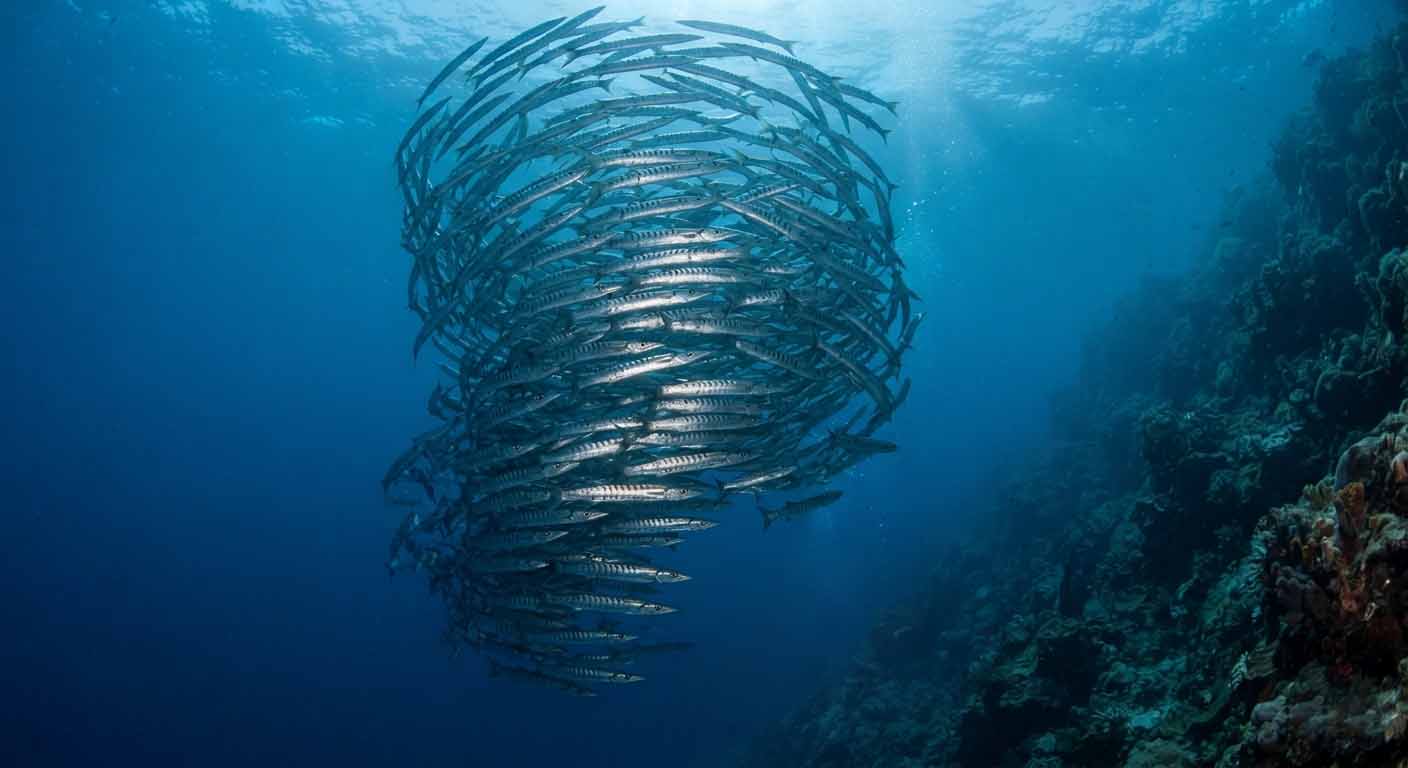
Butuan Bay’s Unexplored Reefs offer something increasingly difficult to find in the Philippines: uncrowded walls with genuine pelagic action. Here, Butuan Bay’s Chevron Barracudas can gather above steep drop-offs connected to the Bohol Sea trench. Hundreds may compress into a spiraling wall of silver, often called a barracuda tornado. Unlike the mostly solitary Great Barracuda, chevrons form social schools and hunt baitfish as a group. The encounter requires planning, however, because currents, depth, and boat support determine whether divers reach the right water safely. Review the bay’s main dive sites and marine sanctuaries before choosing a route. You can also check the FishBase profile for Chevron Barracuda for species identification and range information.
Finding Butuan Bay’s Chevron Barracudas on Butuan Bay’s Unexplored Reefs
Butuan Bay’s Unexplored Reefs and the Silver Tornado
Chevron Barracudas usually patrol outside reef edges rather than over shallow coral gardens. Look toward the blue where the wall meets open water. The school may first appear as a dark band. Then, as it turns, the fish reflect sunlight and reveal their narrow bodies, forked tails, and chevron markings.
Deep water from the Bohol Sea reaches Butuan Bay through natural channels. When that water rises against underwater shelves, it carries nutrients toward the sunlit zone. As NOAA’s explanation of upwelling notes, this process can support plankton and baitfish. Butuan Bay’s Unexplored Reefs sit close to these productive current lines.
Bolihon Point provides a useful example. Its exposed reef structure can split the flow, creating faster water outside and calmer pockets near the wall. Divers considering the site should study the current patterns at Bolihon Point and enter upstream of the expected sighting area.
Punta Diwata offers another likely interception point because its shelves fall sharply into deeper water. Baitfish often collect around changes in depth, especially when moving water pushes them toward the reef. The guide to Punta Diwata’s deep drop-offs explains the site’s caves, walls, and offshore exposure.
Dive Profiles for Chevron Barracuda Encounters
A practical barracuda profile often begins with a negative or prompt descent to 18–22 metres. The group then follows the outer wall while watching the blue. However, divers should agree on maximum depth before entry. Chasing a descending school can quickly turn a planned recreational dive into an unintended deep excursion.
Most encounters occur during the middle section of a multilevel dive. Start deeper, maintain visual contact with the guide, and gradually move upward as gas falls. The PADI Advanced Open Water course overview describes training relevant to deeper navigation, buoyancy, and situational awareness. Equivalent experience also helps.
Gas planning should include current, depth, and the possibility of surfacing away from the reef. Use a conservative turn pressure rather than waiting for a standard reserve. In addition, discuss lost-buddy and separation procedures during the briefing. Divers can review DAN guidance on breathing-gas management before the trip.
Balete Wall can support a shallower finish after time in open water. Its structure gives divers a clear reference during ascent, although the group should not fight the current to reach it. Read the Balete Wall dive profile when planning alternatives. Butuan Bay’s Unexplored Reefs reward flexible teams, not rigid itineraries.
Reading Currents Along the Bay’s Deep Walls
Watch the water before entering. Current streaks, standing waves, floating debris, and the boat’s swing can reveal the surface flow. Meanwhile, fish orientation shows what happens below. Anthias face into mild current, while fusiliers may stream past the wall when the flow strengthens.
Current direction may change with depth. Therefore, descending beside a wall does not guarantee the same route at 25 metres. A thermocline or hazy layer can mark a separate water mass. NOAA’s material on how ocean currents move provides useful background, but local guides supply the site-specific picture.
Up-current corners deserve attention because baitfish often hold there. However, avoid crossing exposed points if the team starts losing ground. Move closer to the wall, reduce drag, and signal the guide. If the route no longer works, begin the agreed blue-water ascent instead of exhausting gas and leg strength.
Local knowledge matters when current predictions lack detail. An experienced captain can position the boat for a live drop and track bubbles from the surface. Booking a Butuan Bay dive with a local divemaster also improves entry timing. For boat procedures, review this guide to Philippine bangkas and deep-water diving.
Skills and Gear for Safe Blue-Water Drifts
Excellent buoyancy control remains the core skill. A diver should hold depth without touching the wall, kicking coral, or inflating the BCD repeatedly. Because the seabed may disappear from view, divers must use instruments rather than visual instinct. Slow breathing also reduces unwanted depth changes.
Every diver should carry a delayed Surface Marker Buoy, reel, cutting tool, computer, whistle, and reliable alternate air source. The SMB must reach the surface from the planned deployment depth. PADI’s advice on using a delayed surface marker buoy covers deployment basics, but divers should practice before joining a fast drift.
Streamline all equipment before entry. Secure gauges, cameras, lights, and alternate regulators so they cannot snag or create drag. Also, confirm that regulators and BCD inflators have recent professional servicing. Cheap life-support equipment adds avoidable risk, as this review of unbranded regulator and BCD concerns explains.
If the team loses the wall, stay together and follow the planned ascent procedure. Deploy the SMB early, complete a controlled safety stop, and listen for boats before surfacing. DAN’s current-diving safety recommendations offer sound preparation. Butuan Bay’s Unexplored Reefs demand calm reactions, especially when the silver school pulls attention offshore.
Best Seasons to Find the Barracuda School
Barracuda sightings can occur throughout the year, but no operator can guarantee a wild school. Water movement, baitfish, rainfall, wind, and offshore visibility all affect the result. In general, calmer sea periods make it easier for captains to reach exposed points and follow divers during open-water ascents.
February through May often brings workable surface conditions, although local weather can change quickly. Visibility may improve when rainfall and river runoff decrease. Still, a strong plankton pulse can reduce clarity while increasing food activity. So, fifteen metres of visibility may produce more action than thirty metres of clear, quiet water.
Ask the operator about recent sightings rather than relying only on annual averages. Also, compare forecasts from the Philippine Atmospheric, Geophysical and Astronomical Services Administration with observations at the dock. The seasonal Butuan Bay diving guide provides additional planning notes for rain, wind, and water conditions.
Build at least two or three diving days into the itinerary. This gives the crew room to select Bolihon Point, Punta Diwata, or a sheltered wall according to conditions. For regional environmental context, consult the Philippine Bureau of Fisheries and Aquatic Resources. Longer stays also reduce pressure to enter when the current exceeds the group’s ability.
Diving with Butuan Bay’s Chevron Barracudas combines pelagic wildlife, steep walls, and true blue-water drift procedures. The silver tornado can last several minutes or disappear after one turn, so disciplined positioning matters more than chasing it. Butuan Bay’s Unexplored Reefs suit divers who can manage depth, current, gas, and SMB deployment without close supervision. Allow extra days, listen to local crews, and choose conditions that match your experience. For a smoother trip, arrange accommodation near the Carmen diving area before confirming boat dates.
Tags: Butuan Bay diving, Chevron Barracuda, scuba diving Mindanao, barracuda tornado, blue-water drift diving, Bolihon Point, Punta Diwata, Philippines scuba travel, advanced scuba diving