
Beyond the Shore: Why Boat Diving is the Ultimate Way to Experience the Philippines
At dawn, volcanic rocks hold the last warmth of night. A wooden bangka waits beyond the shallows. Its outriggers cut a clean silhouette against the rising sun. You step aboard, leaving crowded beaches and familiar reef edges behind. Soon, the coastline fades into a green-blue horizon. Below, the Philippines reveals its most dramatic underwater landscapes.
From Rocky Shores to the Deep Blue Beyond
Shore diving offers simple access, but boats expand every possible horizon. Rocky entries can be slippery, exposed, and physically demanding. Tides may restrict access to the best reef sections. Boat diving removes those limits almost immediately.
A bangka carries divers beyond the breaking waves within minutes. The engine hum replaces the sound of surf. Mountains shrink behind the boat as open water deepens. The first descent may begin above a coral garden or vertical wall.
Many Philippine sites begin far from any convenient shoreline. Deep pinnacles rise from bluewater far beyond coastal reefs. Seamounts attract schooling jacks, barracuda, and hunting tuna. Offshore reefs often receive clearer water and stronger nutrient flow.
Boat access also improves dive planning and surface comfort. Crews can choose protected sites during changing weather. They can follow tides, currents, and marine life movements. This flexibility creates safer and more rewarding diving days.
Inside the Dive Bangka: Built for Bluewater
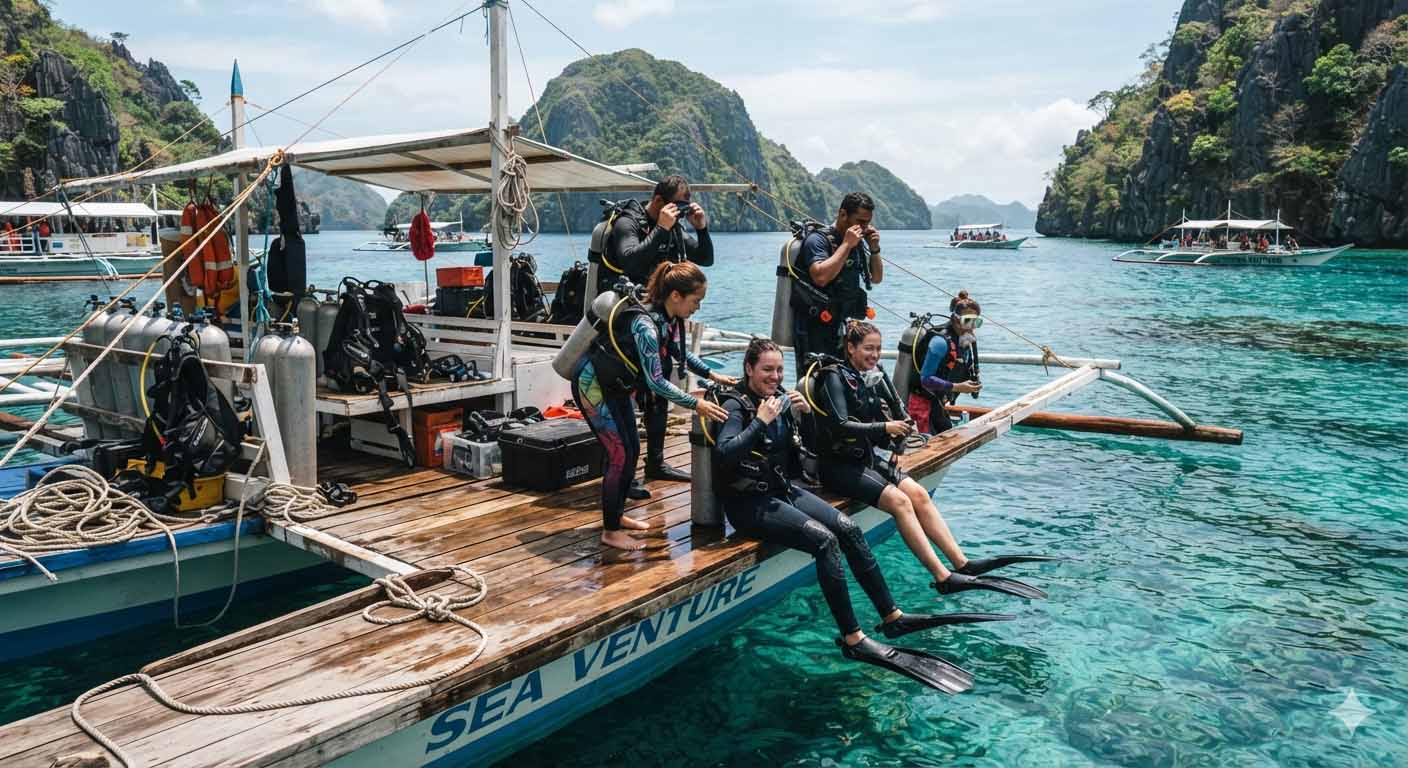
The Philippine dive bangka is more than a cultural icon. It is a highly practical platform for tropical diving operations. Its twin outriggers provide remarkable stability in rolling swells. This matters when divers kit up offshore.
Unlike many narrow fiberglass boats, bangkas offer wide working decks. Tanks sit securely along central racks or side benches. Divers can move without squeezing past crowded equipment piles. Camera systems also receive more space and attention.
The boat’s low profile makes water entries especially easy. Most divers use a controlled giant stride from the side. Others simply roll backward beside the outrigger arm. Reboarding ladders are usually positioned near the stern.
Bangka crews understand local waters with exceptional precision. They read wind patterns, tide changes, and distant cloud formations. They often recognize surface currents before instruments show them. Their experience becomes part of every dive plan.
Drift Diving: Following the Philippines’ Currents
Currents are the lifeblood of many Philippine marine ecosystems. They carry plankton, oxygen, and nutrients across offshore reef systems. Where currents accelerate, marine life often gathers in astonishing numbers. Boat diving makes these moving environments accessible.
Drift diving begins with a planned drop into flowing water. The captain positions the boat ahead of the intended route. Divers descend together and allow the current to carry them. The boat follows from a safe distance above.
Good drift technique begins with buoyancy and situational awareness. Stay streamlined and avoid fighting the water unnecessarily. Watch your group, depth, and changing reef contours. Use a delayed surface marker buoy before ascending.
Deep drop-offs become especially exciting during a controlled drift. One side may hold bright coral gardens near the surface. The other may fall into cobalt water without warning. This bluewater edge attracts pelagic visitors and large schools.
Balete Wall in Butuan Bay is a prime example. Its steep profile creates a powerful sense of vertical scale. Currents can sweep divers past coral ledges and sponge-covered recesses. Experienced guides time entries around local conditions and tidal movement.
Walls demand disciplined depth management and excellent gas planning. Divers can descend too quickly while watching the blue. Maintain your planned maximum depth from the first minutes. Check gauges often, especially during deeper drift segments.
Boat support changes the safety equation around these advanced sites. There is no need to swim back against current. The captain tracks bubbles, markers, and group movement. Divers surface where conditions dictate, not where they started.
Day Boats or Liveaboards: Choosing Your Route
Day boats suit travelers who want flexibility and local immersion. You can dive nearby sites and return before sunset. Resorts often arrange two or three dives daily. This option works well around Dauin, Anilao, and Panglao.
A localized day safari can offer surprising variety. One morning may include a muck dive and coral slope. Another may target a current-swept wall or offshore pinnacle. You also enjoy restaurants, shore excursions, and comfortable hotel nights.
Liveaboards deliver range, repetition, and total diving focus. They reach distant reefs before day boats arrive. Multi-day itineraries can include Tubbataha, Apo Reef, and remote Visayan routes. You wake close to the next descent.
However, liveaboards require more commitment and careful preparation. Cabins are compact, schedules are fixed, and seas may feel relentless. Costs are higher than most day-boat packages. Nitrox availability, emergency oxygen, and evacuation plans deserve close review.
Choose a day boat for flexibility, regional culture, and shorter commitments. Choose a liveaboard for remote sites and intensive diving. Either option depends on a capable crew and sound briefing. Never select an itinerary based on photographs alone.
Before departure, follow these essential boat etiquette and safety rules:
- Keep masks, computers, and cameras secured before the boat moves.
- Use a dry bag for passports, phones, batteries, and spare clothing.
- Keep walkways clear of fins, hoses, weights, and loose accessories.
- Listen immediately when the crew gives entry or pickup instructions.
- Confirm your buddy, entry method, and surface marker procedure.
- Respect marine life, coral, and local fishing activity at every site.
- Stay seated during rough crossings unless the crew directs otherwise.
- Thank the crew after each dive; their skill shapes the experience.
Boat diving transforms the Philippines from a beach destination into an underwater expedition. The bangka becomes your bridge to walls, currents, and distant reefs. Trust the crew, respect the sea, and dive with purpose. Beyond the shore, the archipelago becomes truly limitless.